English common name: Common Cluster Fig
This is a large evergreen tree (10 – 25m in South Africa, but grow up to 45m in tropical Africa), with
a spreading crown and a yellowish trunk that is usually buttressed. It is the largest indigenous fig in South Africa and is associated with a high watertable, occurring along rivers and on seasonal floodplains throughout the subtropical and tropical regions of Africa.
Some examples of the tree:
The figs are large (25-50mm in diameter), yellow to red when ripe and borne in large, branched bunches on the main trunk and older branches.
The Ficus species of South Africa is grouped as rock-splitters, stranglers and trees and although the
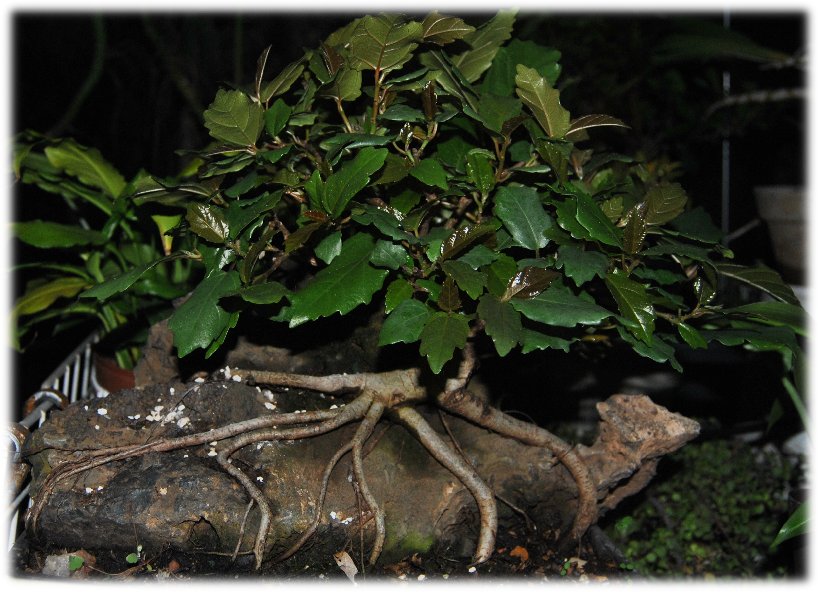
Ficus Sycomorus is grouped under trees and there-fore not as popular as the other two groups for training as bonsai it still produces a fine bonsaitree. The roots are not as strong as the stranglers and rock-splitters but it can be used as root over rock.
Here is a very nice example of a root over rock by Charles Ceronio:
The trunk is strong with a greenish color especially when young. With care an excellent taper can be achieved.
An example of a dug tree with massive taper:
The leaves are large on natural trees but they do reduce in size with the correct training over time, it is more suitable for larger trees.
The Sycomorus likes to be well watered especially in warm summer weather but more sparsely in winter. It is not frost hardy and should be protected in winter in areas receiving frost. It is suited for more informal styles such as informal upright and also root over rock. This tree should be kept outside in full sun to semi shade.
Repotting should take place every one to two years for young trees, and every three to four years for mature specimens. Medium to deep containers are preferred.
Normal fertilizer should be applied at a regular interval.
Heavy pruning should be done during the warm season when healing will be at its best.
Propagation is easily done by cuttings and truncheons.
♣
Ficus sur is a large, fast-growing, evergreen tree, reaching
up to 35 m high, with large, oval, green, sometimes slightly serrated on the edges, leaves borne on a massive,
spreading crown.
The typical leaf form of the trees here in Rustenburg, South Africa:
Figs are produced throughout the year in South
Africa. They are borne in large clusters mostly low down on the
trunk and can even appear at ground level or below the ground arising from the roots.
The racemes with fruit:
This majestic giant stands proud along side rivers
and waterways throughout the eastern and northern regions of southern
Africa- this indicate that they need a lot of water all the time!
It is restricted
to frost-free areas with moderate rainfall.
The species is not well known or used much in the bonsai world but they do have potential:
- They transplant easily.
- They grow fast.
- The leaves do reduce well.
- They can be grown into any style and all the sizes except for the smallest.
- They fruit on young trees.
- The bark is multicolored.
- No major pests or diseases.
- Trees can be fused.
Most of my trees are grown from self sown seedlings - interesting enough they germinate in my pots and planting bags where other trees are growing in. Here you will never find them germinating in open soil in garden beds or even in the veld.
They rarely grow as stranglers or root over rock because the roots dry out too quickly.
When the trunks have reached the desired thickness the trees can be cut back and potted up. This is done when the trees are growing actively in high summer - digging up the trees in winter normally lead to their deaths by rot.
This is a yamadori I dug up in mid winter 2010:
It died! A very high prize to pay for gaining experience. Nowadays I do wait for the weather to warm up before digging this trees.
The trees recover quickly in summer and work can be done by the end of summer. Here is one potted up last summer(2011) and the chop worked off in April 2012:
Branches or trunks of this species can be fused. Here is three twigs that were fused using cable ties in 2009:
The same branch Aprl 2012:
One of the twigs died but the other two fused well. I will not use this for fusing branches again because a single twig could have grown as thick as the fused ones in the same time. Fusing trunks could be an option with this species.
To get ramification of the branches the tree should be left to grow freely for a while(at least four adult leaves) before being cut back to the last leaf. The last leaf can also be reduced by about 75%. Here is a tree that have been left to grow freely before being cut back and defoliated:
Defoliated and cut back:
From here it is important to pinch the new growth back to the second last leaf if you want to keep the leaves small. Defoliating can be done a few times in summer and autumn.
It is best to wire trees to style them but make sure that the wires don't bite in.
Wounds on the trees heal well and the deadwood last quite long. Here is the cambium rolling over after the worked off chop:
Trees can probably be grown into any styles but I believe an open umbrella suits this species well. It can be grown root over rock but you may get roots dying if they get too hot in full sun. Racemes and fruits forms on young plants and can be left as a nice talking point!
The trees can be planted in a high organic medium - 50% gravel and a good compost will do fine. The high compost content will also prevent the tree from drying out too quickly - on this species drying out may lead to massive die back! This species responds well to organic or inorganic fertilizers.
The nebari on this species can be build by using sacrifice branches.
Progression of a Ficus sur bonsai:
November 2011:
February 2014:
From the top:
The yellow indicates the current front. The front will change when the rest of the canopy has caught up with the area indicated by the yellow arrow.