Showing posts with label Bonsai. Show all posts

Thursday, July 17, 2014

Holmskioldia sanguinea (Chinese hat plant) - This is going to be a lot of fun!

I was lucky enough to get this species from the school where I am a teacher. We enlarged a lawn and most shrubs were removed. This one is about 50 years old:
 March 2013:
 This is the flowers of the species:
 The leaves - now we can see it is part of the mint family:

Some info on the species:

Named after Theodor Holmskiold, an 18th Danish physician and professor, Chinese hat is native to the Himalayan lowlands and is an erect climbing shrub that bears narrowly trumpet-shaped flowers with crimson petals and orange-red calyces. Its unique flowers are the main interest of this scrambling shrub: each is a narrow, orange-scarlet tube backed by a broad, circular calyx, appearing in dense terminal clusters through fall and winter. The mid-green leaves are oval and slightly serrated. There are also yellow- and bronze-flowered forms.

  PRUNING... This tree is a very rampant grower. Prune weekly back to the first or second node on secondary branches while actively growing Will handle severe top and root pruning.

 TRAINING... Wire for movement in main branches and use clip and grow for secondary branches. Due to its quick growth rate watch for wire scarring.

 WATERING... As any quick grower it likes a lot of water during the summer months.

 LIGHT... Full sun is best. Although can tolerate partial sun.

 INSECT/DISEASE... Watch for Scale, Mites and Aphids.

 FERTILIZE... Careful with the nitrogen, too much will stretch the internodes. Use a balanced fertilizer through the growing season then start adding phosphate late summer for blooms.
 REPOT... Repot every one to two years.

 SEASONAL... Protect below 40 degrees. In your landscape will freeze to the ground and come back, but will need some protection on a sustained freeze. 


The one I have dug in winter(July 2014):


 Time will tell.......but it is going to be a lot of fun!


Monday, July 14, 2014

Celtis africana - bridging the big wound.

June 2009:

I can not really remember where I got this material. The biggest problem with it was the big ugly wound low down.

March 2010:
 I have cut back some of the thick branches and is slowly rebuilding the branches. There is a big wound but the cambium is starting to roll over so over time it will be healed. The wound extends just above the lowest branch downward to the left. The branch indicated with the pink line (picture 3) is going to help heal that area (closeup picture 4).


The branches and twiggy growth are coming along nicely  - the wound is still a big problem!


October 2012:
I have used one of the twigs to bridge the wound.


June 2013:
The graft/bridge has fused well.
The tree today:


Un update-July 2015:


Comparing 2014 and now:


Tuesday, July 1, 2014

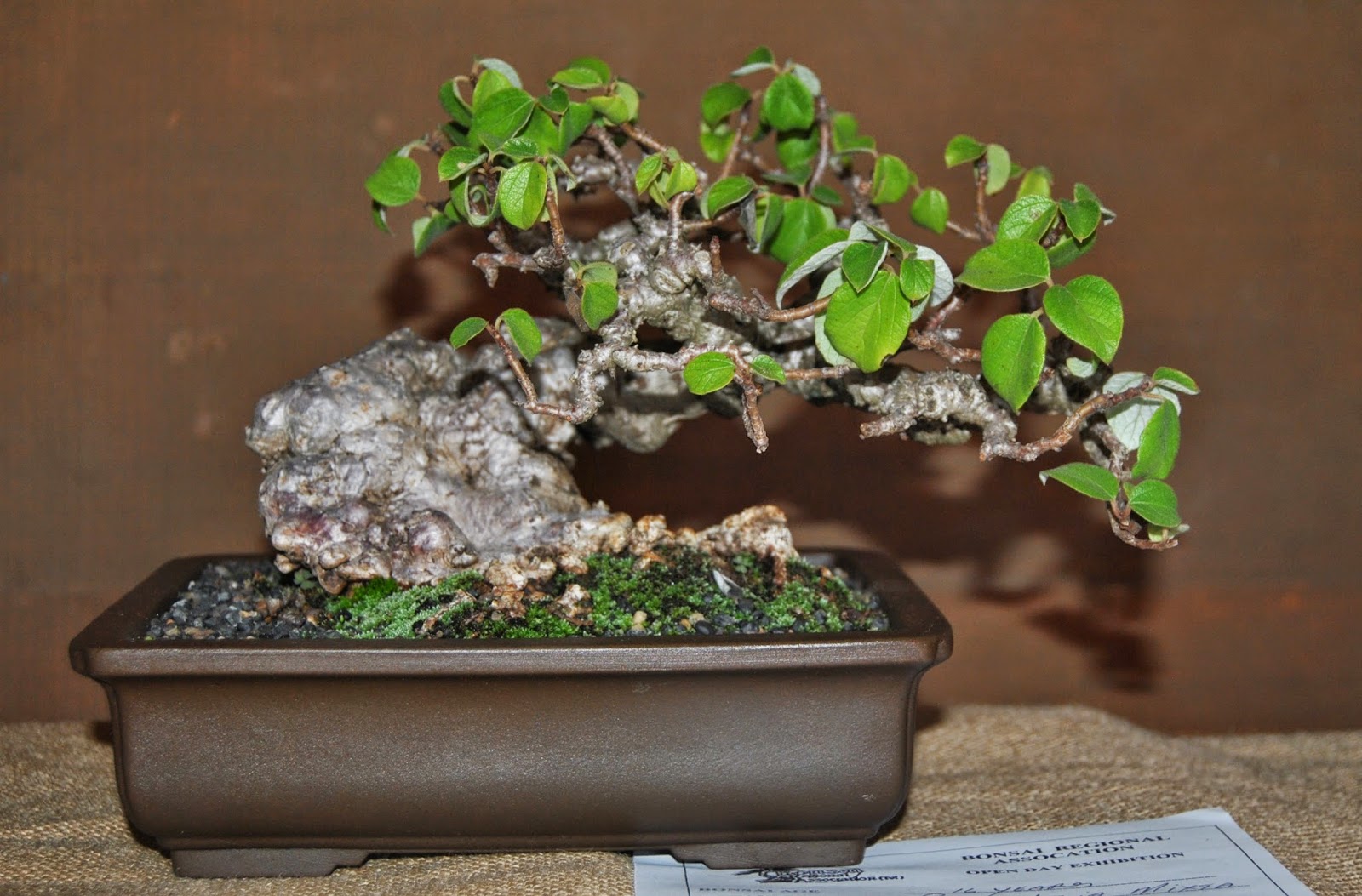
Brat open day at Far West Bonsai Kai on 31 May 2014

Some pics of the trees:
(Pic quality not so good.)

Portulacaria afra
 Olive and Buddleja saligna
 Buddleja saligna
 Buddleja saligna
 Buddleja saligna
 Ficus Burtt davy
 Ficus
 Maple
 Olive
 Olive
 Olive
 Smaller trees
 Soap Nettle

Sunday, May 4, 2014

Ficus benjamina var. "Wiandi" - Cinderella of the species as bonsai!

 When I started bonsai I bought three Ficus benjamina "Wiandi" trees because they look bonsai"ish", a Mallsai without any training because they grow contorted without any help.

This is a typical plant sold by nurseries:


While trying to grow them into bonsai I realized that they can not easily being forced into something I envisaged for them:

-They never back bud  where I want them to, sometimes they don't even back bud at the last leaf but two, three leaves back!
-The taper of this trees trunks are horrible, they thicken the trunk where they want to! Where the branches enter the trunk there are sometimes horrible swellings!
-There are no signs of a nice nebari, one or two thick roots is all you see!
-Defoliating kills branches and leaf reduction after the defoliating is not worth the trouble!
-You cant bend branches, they snap right off!
-Wires leave marks very quickly.
-Nodes are long, so ramification is a problem!
-Working on the lower trunk(some slits to try and get thickening) my one tree rotted!
-They grow sloooooow!

 and

They cant take the cold!

I have done a Google picturesearch to get some nice examples of finished Ficus Wiandii bonsai....but I could only found one!

(Owner of above tree unknown.)


Why do I keep them?

Because they are strange little trees!

  The history of the variety:

"The present invention comprises a new and distinct cultivar of Ficus benjamina. The varietal denomination of the new cultivar is `Wiandi`.

The new variety was discovered as a mutation in a controlled planting of Ficus benjamina `Natasha` in a greenhouse in Aalsmeer, The Netherlands. The new cultivar was discovered as a whole plant mutation and was isolated in a glass house in Aalsmeer, Holland.

SUMMARY OF THE INVENTION

The new variety is a mutation of the variety Ficus benjamina `Natasha` and differs significantly in growth habit and appearance from its parent. Whereas Ficus benjamina `Natasha` exhbits a vertical, upright growth pattern which reaches a height of one meter in approximately nine months, `Wiandi` will take approximately two years to reach this height. Also, the growth pattern of `Wiandi` is irregular and the growth form is substantially horizontal, or laterally dominant with zig-zag pattern between internodal spacing. Although growth of the new variety will eventually progress vertically, it does so much slower than its parent, as indicated above.

The term "Zig-Zag" is an acceptable botanical term denoting a botanical growth form. As used herein, the new variety, `Wiandi,` maintains a decumbant growth pattern in addition to its irregular branching. Its growth habit is horizontally dominant as opposed to apically dominant Ficus varieties like the parent `Natasha`, and Ficus benjamina. Its branches take irregular angular turns between leaf internodes and internode distance is also irregular. Lengths between leaf internodes on thesame branch have been measured at 7 mm, 11 mm, 18 mm and 20 mm. These length differences do not appear to fall into any pattern along the branch, but are observed at random. For instance, internode length does not necessarily increase or decrease laterally along a branch. In addition, it is very rare to find a successive internode that does not angle off from its preceding internode. Growth does not continue along a relatively straight line as it does with `Natasha`. Without manipulation or pruning, it is not uncommon to see angulation of successive internodes as great as 90.degree.. Greater angulation of branching has been achieved or induced by pruning of the apical branch tip. With pruning, angulation of the growth between internodes has been observed as great as 150.degree.. `Wiandi` also has been observed to throw multiple ariel roots (branch prop type), particularly when grown under hot humid contitions such as in Homestead, Fla., during the months of January to September. In Florida, it has been observed that the leaf size increases during the warmer months, as does Ficus `Natasha`, and then decreases during the cooler months. Leaf sizes stated previously indicate the smaller leaf size cycle which is most typical of the plant."

( http://www.patentgenius.com/patent/PP9207.html)

 I bought this nursery plant in 2009:

 The tree April 2011:
 May 2012:

July 2012:


April 2014:


  Oktober 2019:


Another one - picture 2009:

 The same tree April 2014:


Another one:

A forest/setting in the making:
2009

2012

For the fun of it:
April 2014 - needs a bit of work!
This was not my plan for this one - the tree has styled itself like this:


 Another one that will have to be chopped summer 2014: