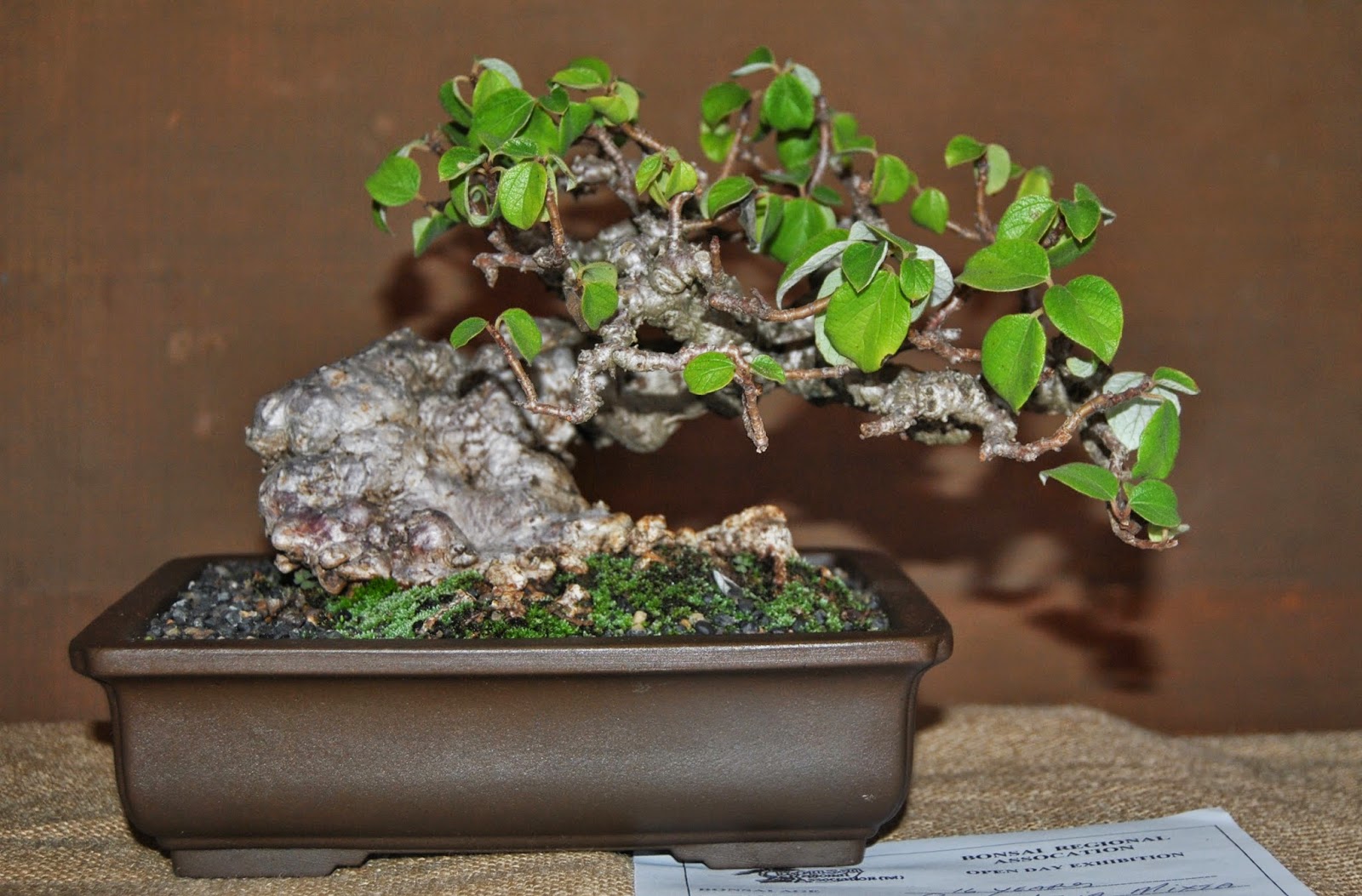
When I started bonsai I bought three Ficus benjamina "Wiandi" trees because they look bonsai"ish", a Mallsai without any training because they grow contorted without any help.
This is a typical plant sold by nurseries:
While trying to grow them into bonsai I realized that they can not easily being forced into something I envisaged for them:
-They never back bud where I want them to, sometimes they don't even back bud at the last leaf but two, three leaves back!
-The
taper of this trees trunks are horrible, they thicken the trunk where
they want to! Where the branches enter the trunk there are sometimes
horrible swellings!
-There are no signs of a nice nebari, one or two thick roots is all you see!
-Defoliating kills branches and leaf reduction after the defoliating is not worth the trouble!
-You cant bend branches, they snap right off!
-Wires leave marks very quickly.
-Nodes are long, so ramification is a problem!
-Working on the lower trunk(some slits to try and get thickening) my one tree rotted!
-They grow sloooooow!
and
They cant take the cold!
I have done a Google picturesearch to get some nice examples of finished Ficus Wiandii bonsai....but I could only found one!
(Owner of above tree unknown.)
Why do I keep them?
Because they are strange little trees!
The history of the variety:
"The present invention comprises a new and distinct cultivar of Ficus
benjamina. The varietal denomination of the new cultivar is `Wiandi`.
The
new variety was discovered as a mutation in a controlled planting of
Ficus benjamina `Natasha` in a greenhouse in Aalsmeer, The Netherlands.
The new cultivar was discovered as a whole plant mutation and was
isolated in a glass house in Aalsmeer, Holland.
SUMMARY OF THE INVENTION
The
new variety is a mutation of the variety Ficus benjamina `Natasha` and
differs significantly in growth habit and appearance from its parent.
Whereas Ficus benjamina `Natasha` exhbits a vertical, upright growth
pattern which reaches a height of one meter in approximately nine months,
`Wiandi` will take approximately two years to reach this height. Also,
the growth pattern of `Wiandi` is irregular and the growth form is
substantially horizontal, or laterally dominant with zig-zag
pattern between internodal spacing. Although growth of the new variety
will eventually progress vertically, it does so much slower than its
parent, as indicated above.
The term "Zig-Zag" is an acceptable
botanical term denoting a botanical growth form. As used herein, the
new variety, `Wiandi,` maintains a decumbant growth pattern in addition
to its irregular branching. Its growth habit is horizontally dominant as
opposed to apically dominant Ficus varieties like the parent `Natasha`,
and Ficus benjamina. Its branches take irregular angular turns between
leaf internodes and internode distance is also irregular. Lengths
between leaf internodes on thesame branch have been measured at 7 mm, 11
mm, 18 mm and 20 mm. These length differences do not appear to fall
into any pattern along the branch, but are observed at random. For
instance, internode length does not necessarily increase or
decrease laterally along a branch. In addition, it is very rare to find a
successive internode that does not angle off from its preceding
internode. Growth does not continue along a relatively straight line as
it does with `Natasha`. Without manipulation or pruning, it is not
uncommon to see angulation of successive internodes as great as
90.degree.. Greater angulation of branching has been achieved or
induced by pruning of the apical branch tip. With pruning, angulation
of the growth between internodes has been observed as great as
150.degree.. `Wiandi` also has been observed to throw multiple ariel
roots (branch prop type), particularly when grown under hot humid
contitions such as in Homestead, Fla., during the months of January to
September. In Florida, it has been observed that the leaf size increases
during the warmer months, as does Ficus `Natasha`, and then decreases
during the cooler months. Leaf sizes stated previously indicate the
smaller leaf size cycle which is most typical of the plant."
( http://www.patentgenius.com/patent/PP9207.html)
I bought this nursery plant in 2009:
The tree April 2011:
May 2012:
July 2012:
April 2014:
Oktober 2019:
Another one - picture 2009:
The same tree April 2014:
Another one:
A forest/setting in the making:
2009
2012
For the fun of it:
April 2014 - needs a bit of work!
This was not my plan for this one - the tree has styled itself like this:
Another one that will have to be chopped summer 2014: