The stump December 2009:
This was a tree that was planted above some sewage pipes and I had to remove it before any damage was done. The tree responded well to the transplant. Not to waste any material I decided to do an air layer. The first step was to cut open the side and bottom of a plastic basin. A hole was also cut to accommodate the trunk:
Some rods driven into the trunk to keep the basin in place:
The cut:
The palm fiber and gravel medium:
Air layer finished:
To force roots to grow strong I removed pieces of bark directly underneath the basin. Here is the last bit of bark left:
The air layer removed June 2010:
I decided not to do another air layer so I ringbarked the tree to force growth lower down:
As you can see the tree responded by growing roots and leaf growth.
A close up of the roots:
It seems that the mentioned roots and the new growth were formed by meristematic growth.
I did a lot of internet search about the layers that make up a tree and
also on the plant cells making up the layers but could not find anything
on this.
This type of growth occurs on other trees and plants also but mostly on
the lowest part of the plant as in cuttings. Here you will also find
some of the new roots of a cutting coming out of the area between the
bark and the "woody" part of the plant. It seems to me it has something
to do with Auxins, which appears to usually go down(but some upward
movement is possible) from the growing tips and they accumulate at the
cut point of the cutting. what they do there to "change" the cells I
could not figure out.
The same Auxins seems to be the stimuli for waking up normal buds(where
leaves were on trunks) and it seems that some trees need some foliage to
wake up buds as in Ficus benjamina. (Maybe the few leaves left is
needed to make more Auxins to send down to the buds. It also seems that
some trees are able to store these Auxins because you can chop them
without leaving any growth points. And it seems that some older trees of
some species are able to store this Auxins when they are young but not
when they are older : some trees you can chop when they are young and
they will rebud, but the same species if ringbark when older will die -
that's the way they kill big Bluegums and Black wattles here in
South-Africa.
Back to my Ficus. most Ficus species seems to have the ability to store a
lot of Auxins and when needed it is possible for sending them not only
down but also up- so much that not only the latent buds wake up- they
have the ability to "reorganize/regroup" cells (specialized) to fulfill
other functions than that they were ment to do.
Thinking back on the history of the growths on my tree I remember it
sending out new growth where latent buds were - only after cutting these
growths back, did this strange growths appear. Is it not a case of the
new growths making new Auxins and as a last resort the Auxins
concentrate at the top and this is when the strange growth appeared?
Or is this just a case of life finding a way?
New growth from the ring bark area July 2010:
A close up of the growth showing that they originate from the cambium and not latent buds:
Another:
The top part removed September 2010:
I wanted to see how the nebari is looking and decided to clean up the nebari and make a new "pot" for the tree.
Roots exposed :
....and some work done with a new "pot" January 2011:
Growing happily in it's new pot with new medium added
The tree left alone to thicken up the branches February 2012:
I have cut back the tree two times this year to prevent the branches tearing from the trunk because of the weight and to get some secondary and tertiary branches going. This is the tree March 2013:
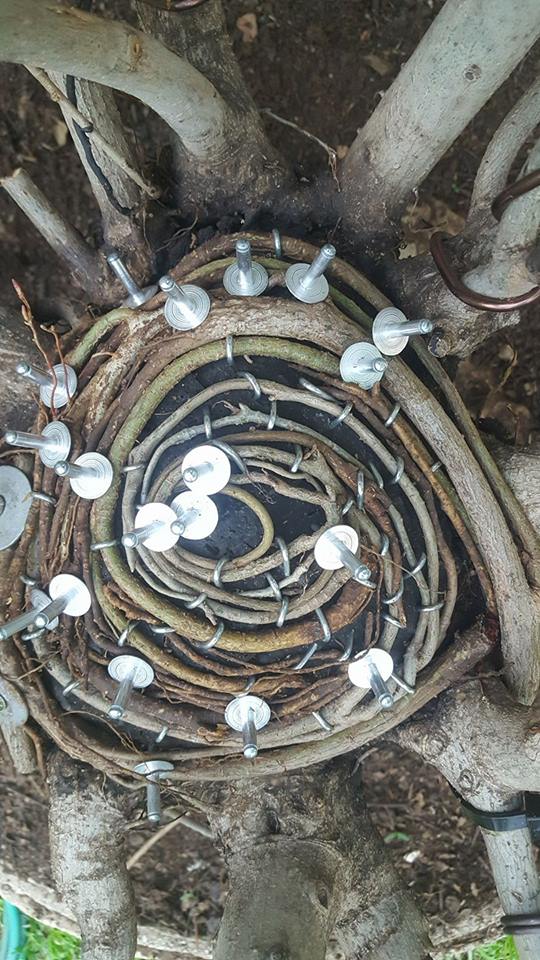
In the next three pictures one can see a lot of aerial roots forming. This opens up the possibility of using the roots and twigs to close up the chop by fusing them.
The tree is growing very vigorously because I feed it with chicken manure pellets and horse stable manure on a regular basis.
The tree early this afternoon (October 2013):
After the cut back:
I still have to cut back a few other branches and twigs and put some wire on the tree.
The wound was sealed by a rubber kind of sealant because the core was cracking letting in to much water.
I was thinking of hiding the chop by....
1. Fusing air roots(some can be seen and new ones are forming.) and grafting in an apex.
2. Forming an apex by bending twigs back to the center and letting them fuse.
3. Hide the chop with the branches.
I am going to work away the soil below the "pot" to free the tree from the soil it is standing on. Going to be a big job but I will have to: the tree is standing close to a Jacaranda and the branches closest to the Jacaranda are suffering.
September 2016. At last I have removed the tree to a new spot where it will get some sun again. For the last two years I have cut back the tree and did not do much work. Some of the lower twigs have died because they did not get enough sun. Removing it from the ground was quite easy - when I planted it way back
it was placed on top of the soil with some very thick plastic below it.
Pics of the move:
More pics of nebari - front not yet decided on:
Cleaned out the wound - not too much rot:
Using styrofoam I filled the wound up again:
Sealed up again:
I will have to use roots and twigs to cover up the wound and at the same time build a new central leader/apex.
December 2016
Defoliation of the big Ficus.The tree grew well after
the move in September. To get more twiggy growth to fill in the gaps
and to strengthen the lower branches and twigs I cut back and partially
defoliated the tree. To protect thin twigs from dieback I do leave the
last stalk and a small piece of leaf. The last pic shows the result of a
successful defoliation - 4 new buds going!
8 January 2018- The tree is ready for its first styling and me and the tree has agreed on not hurting each other too much:
I have finished wiring the tree. Tomorrow I will do the final bending and branch positioning tomorrow. Then I will remove some of top soil and replace it with fresh compost. Organic fertilizer will be given and Saturday the tree will be defoliated.
These roots were grown on purpose and will be used to cover up the wound/chop. A cetral "trunk" will also be fused onto the roots. After fusing the roots will be cut at the origen.
Today I removed some of the old soil and replaced it with fresh compost. Thos gave me a change to free the air roots I want to ise to cover up the wound. The nebariroot area still needs some work in regards to secondary and tertiary roots. Some pics of the roots:
Today I placed the roots on the wound to get the closing up process started. In time there will be more roots forming and they will fuse. I am developing a twig that will be fused in the middle and over time this will become the centre branch/trunk.
The tree August 2018. Cut back and defoliated again.
7 March 2019
The roots to cover up the wound has fused nicely, but there were certain areas where the roots died back. Luckily the tree grew a lot of new aerial roots and it was possible to close up the areas:
The fused roots will look like bark over time. I have achieved what I wanted and that was to close up the wound. This will prevent water damming up. Over time some roots will grow down the rotted core and I will have to keep them in check, or I will let nature take over and see what will become of the tree. I am still planning to fuse/graft in a center branch to get some taper going.
The air layer was not a big success:
It seems that vertical veins running from a twig to a root, plays a big role when it comes to very big but short air layers like this. Vertical bark areas, even when there were growth, died back if there are no roots feeding them directly?
The part that has remained, do present another interesting opportunity.