Thursday, June 21, 2012

Acacia burkei/Black Monkey Thorn progression.

The tree August 2010:

 I got the tree from a bonsai friend in July 2009. The left hand branch was still a twig and the initial idea was to use it as a sacrifice branch to thicken the trunk lower down.

The defoliated tree January 2011:

 The defoliation was an experiment because there was not much information on defoliation of Acacia. The tree responded well by a lot of back budding and smaller leaves.

The tree October 2011:


 In the last picture I am growing a new lower right branch.

Here is the tree March 2012:

The new branch have thickened very quickly. I will probably cut it back in spring to get the taper of the branch right.

The tree 19 July 2012:

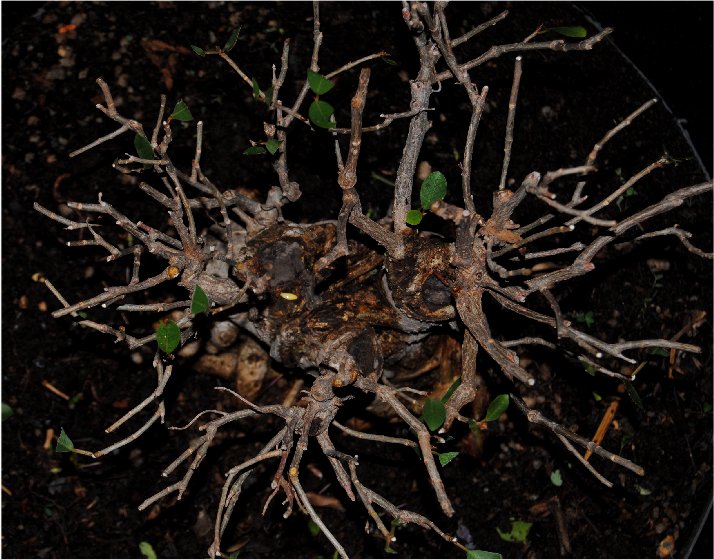
 I also cut it back because the buds were swelling. Here is a picture from above showing where I planned to cut and a few branches I have to move a bit:

The Black Monkey Thorn normally bud out on the last bud on a twig. Cutting it back heavily normally wakes up buds lower down. Here is a virt showing you the potential buds when you cut back:

When you cut back at the yellow line the yellow arrows indicate where you may get buds going. Cutting back at the purple line(that twig was the primary bud), there are two secondary buds latent that may start growing.

The latest pic, October 2012:
The tree was cut back once this season. As soon as the buds swell I am going to defoliate the tree. After this the canopy will be left alone except for regular pinching. There are two twigs growing lower down that will be left to grow freely to thicken up the base and create a little more taper.

November 2012- defoliated and some twigs rearranged:

 For the rest of the season I will only pinch the growth and enjoy the tree.

March 2013-just as autumn is starting:

I have only pinched back the new twigs to two leaves the last few months. In winter I will probably compress the crown a bit to prevent it from looking top heavy.


Tuesday, June 12, 2012

Ficus burkei sumo trunk

I have bought this Ficus from one of our Kai's members He sold some of his trees because he moved to a colder area of RSA.

This Ficus was 27 years old when I bought it in June 2009 and I have paid about 100 US dollars for it. The tree stands about 60cm high.

Ficus thonningii
is a species of Ficus. It is native to Africa. Recent phylogenetic analysis suggests several distinct species may be classified as F. thonningii.
http://www.figweb.or...icus_burkei.htm


 This is probably Ficus burkei:


 I chopped the branches back December 2009 to get some lower branches going:

I also repotted the tree into a bigger container and from there the growth was very slow but I did get some twigs going. Here is the tree October 2010 after another cut back:


The tree is growing much slower than I have anticipated - I do believe the roots are filling the pot and the tree is storing all of it's energy there and not in new growth. As soon as the roots have filled the pot I do believe I will get some better growth. Here is the tree October 2011:

After the cut back:


I will leave it in this pot for another two years. In spring I will select and wire the twigs. The sharp taper from trunk to branches need to be softened - I will try and grow it into an open umbrella style.

I have defoliated the tree again and cut it back. Hope to get a lot of buds going.
Here is the newest pics November 2012:


 The biggest part of the original nebari is still covered in the hope of getting some horizontal roots going.

From the top:
 Will update again after it has budded out.

I am not getting the fine twiggy growth that I am hoping for. I have potted the tree into a new bonsai pot:

I have not placed the tree correctly in the pot and the color of the pot is not complimenting the tree.

Will fix this next growing season.

In the meantime I have defoliated the tree to try and get more twiggy growth.


Saturday, June 9, 2012

Ligustrum / Privet - another exotic.

I got this trunks in June 2009:

 In November 2009 I wanted to do tanuki kind of thing bringing a lower shoot up as the first branch to the left:
This shows the twig I wanted to use:


I have decided against that because the growth on top seemed to enough to keep the tree healthy. Here is the tree 2010:


This is the tree three years later:
I did some carving on the roots and painted all the deadwood with lime sulfur without cleaning the wood first. This left the deadwood dark.
The tree September 2012:

It was shown at a regional competition and there were a lot of positive remarks. The tree needs to placed a little above eye level to be really appreciated. The third branch from below on the left hand side needs to grown out a little bit more. I will defoliate the tree very soon to get the leaves reduced.

November 2013:


Saturday, May 26, 2012

Acacia bonsai - Africa's pride!


Acacia in the Pierneef open umbrella style.


The following information has been copied from

http://www.zululandbonsai.co.za/

(Additional personal experience will be added in bold.)

The most successfully grown acacia for bonsai are:
  • Acacia burkei – black-monkey thorn / swartapiesdoring.
  • Acacia caffra – common hook thorn / gewone haakdoring.
  • Acacia erioloba – camel thorn thorn / kameeldoring.
  • Acacia galpinii – monkey thorn / apiesdoring
  • Acacia karoo – sweet thorn / soetdoring.
  • Acacia nigrescens – knob thorn / knoppiesdoring.
  • Acacia robusta subsp. clavigera – narrow-pod robust thorn / brakdoring
  • Acacia robusta subsp. robusta – broad-pod robust thorn / enkeldoring.
  • Acacia sieberiana var.wookii – paperbark thorn / papierbasdoring
  • Acacia senegal var. rostrata - Driehaakdoring
  • Acacia erubscens- Blouhaak
Roots – Most acacia have a tap root system which is not conducive to bonsai cultivation.  Shortening the tap root over a period of 2-4 seasons will force a number of adventitious roots to develop. In time, this will produce a workable flat root system. Although good surface roots are rarely formed by acacia. Pieter du Plessis is experimenting on using a washer to layer of the taproot on younger trees - the reuslts are very promising. After removing the dead taproot he is planting the trees on tiles.
Bark – Most acacia bark is rough and has a tendency to flake.  The exception to this is Acacia karroo, which has fairly smooth bark when young.
Trunks – Acacia trunks are usually flexible and single when young but at a later stage split into low, heavy branches.  Healing is relatively easy if the tree in encouraged to expand.  Pruning back will, in most cases, result in a crop of new branches. Tapering may be problematic as the trees carry only a few sparse branches at a time.
Branches – The branches are often mistaken for multi-trunks due to their size and the fact that ramification is poor.  The branches are known to weaken if they are grown in a descending manner.  It is therefore in the trees’ best interest that it is treated as it is in nature with a short trunk and low, ascending branches.  There should be no evidence of a definite apex, but rather a crown formed by a multitude of branch ends.
Leaves – The species has difficulty in forming a large number of small branches, but this is compensated for by compound, bipinnate leaf formation.  Each branch bears a long leaf stalk and a multitude of leaflets which take the place of fine twigs.

In January 2014 I took these pics of an Acacia with an amazing nebari - the biggest nebari I have ever seen on the species:


20cm high Acacia senegal var. rostrata 2 years in training in the Pierneef style:

Pieter du Plessis visited our Kai on 20 April 2013 and did a talk on Acacia. Here are some of the trees he brought along:

White Monkeythorn:
 White Monkeythorn:
 Black Monkeythorn:
 This Monkeythorn is 30 years in training and grown from seed:
 Black Monkeythorn 20 years grown from seed:


African Bonsai Styles
1. Baobab Style
2. Pierneef Style / Open umbrella Style
3. Flat Top StyleBushveld or Natural Style (Shizen-zukuri)

4. Bushveld or Natural Style (Shizen-zukuri)
Images courtesy of SA Bonsai

Celtis - from semi formal to flat top.

The self sown seedling in 2009:


I chopped it and picked up a new leader for a typical semi formal tree:


I decided against that and pull the twig down. I have decided on a flat top for now:

The tree January 2011 after a cut back and defoliation:


I am very happy with the direction I took with the tree. Except for some pinching I let the tree grow freely this year:


In early August  will cut it back, reduce the roots and pot it up for the first time. I am still deciding if I am going to use a slab, a hollowed out rock or a conventional pot.

November 2012:

 July 2014:
 July 2014 - cut back and ready to grow: