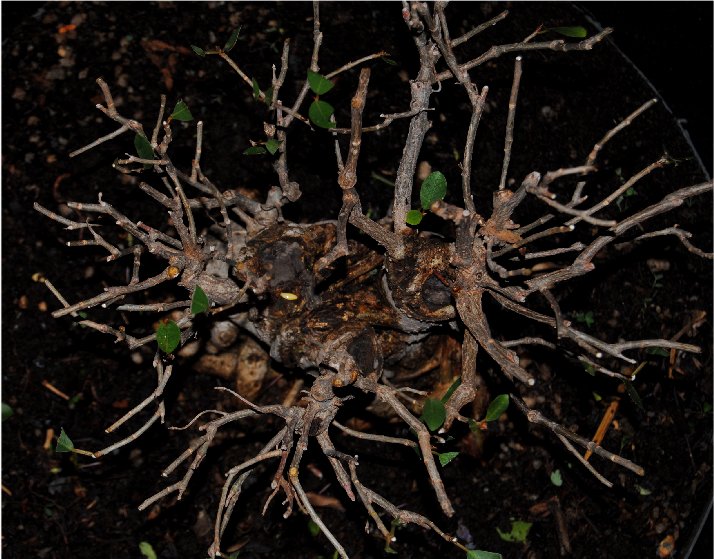
I got this Buddleja saligna yamadori in 2009:
What drew me to the tree was the nebari: it looked good from a few sides. I did not have a formal upright tree so I decided to style this one as an old formal upright lightning struck tree with sweeping downward branches.
The species is an ideal bonsai candidate for the style because the leaves reduce very well and the wood is quite hard - a tree this size is probably more than 50 years old!
The biggest problem with this species, especially on older trees, is that the roots are directly connected to certain branches. When digging the yamadori, it is not normally a problem, but when working on a tree a cut root can mean a dead branch. It can also mean that the "vein", connecting the two may die leaving you with dead bark and later a deadwood strip.
The tree also bud out on these veins, so the branches on a vein must be balanced to keep each branch on the vein an equal chance to survive- if the lowest branch on a vein is left unchecked, higher up branches may die.
Because the tree is basal dominant it was important to me to get the highest growths as strongly growing as possible.
I carved back the top of the trunk to the last living buds to create some taper. This would be refined later on. The biggest reason for the carving at that stage was to see which buds/growths would survive.
The tree after the carving:
The new apex was picked up and wired to the deadwood. I was crucial that I get it as healthy as possible and with so much growth as possible so I decided to grow a little trunk line with branches there. Here is the apex picked up:
The tree June 2010:
As the tree was budding out I bend the twigs downwards as soon as possible to prevent them from being torn off the trunk later on. At that time I still need a lot of branches so I nurtured every bud showing by cutting back older branches.
By October 2010 the tree was coming along nicely:
Much needed higher and lower branches has budded out.
By December 2010 I decided to extent the carving to where the bark has died naturally:
February 2012 I extended the deadwood to the base of the tree:
In April 2012 I decided to thin out the foliage a bit because the inner leaves began to go brown - they were not getting enough sunlight.
Big mistake!
After the thinning we had a cold spell and the tree suffered through winter. Winter here is May-July. Early July I slip potted the tree into a bigger container because it showed new growth. It has recovered well and I did some refining carving.
Will update with the newest pictures in the next week.
My progression in bonsai and information on African species used for bonsai. (Most information was copied from the net. Personal experience was added where necessary.)
Sunday, August 5, 2012
Wednesday, July 11, 2012
Eugenia (Brush Cherry)- Lollypop to broom.
This is a Eugenia I got from a friend -it was grown as a lollipop tree:
10 months later and I've decided(sort off) on a front.
I have replanted it into a shallower "growth box". I have wired the branches and I worked on the ramification and leaf reduction. I've found that by pinching and partial defoliatiion the leaves reduce nicely. That's why the branches are quite bare now. I want to grow two new lower branches- that's what you see lower down. The yellow arrow indicate the only branch that i have not cut off.
I'm also leaving a very low growth to help building the taper of the nebari- luckily there is some flare there.
From the top:
The nebari:
I have added some soil around the base to help build the nebari - I really needed some roots there!
I have defoliated the tree to concentrate the growth into the new lower branches and also to get some backbuds growing in the center of some of the branches. The defoliating will also add to leaf reduction.
October 2010. I have replanted the tree into a bonsai pot and it has taken it quite well. The new lower branches is thickening quickly. There is a bud that has started to grow lower down and I am going to let it grow to help build the base.
I have defoliated the tree again in February.
Before:
After:
From the time I have partially defoliated the tree in February I tried my best to get the leaves as small as possible and I think I am winning:
After the defoliation I pinched after the next two "true" leaves and cut the leaves back close to the stalk. After this I am starting to get the very small leaves which normally shows as bumps/eyes/buds before the "true" leaves. I pinch again just after the small leafs. When I get too big leaves I cut them back to the stalks. I believe by keeping this up I will get the needed leaf reduction to make the tree look believable.
This has become one of my favorite trees. Due to regular pinching and defoliation I got too much ramification and the branch structure was hidden by all the foliage. It started to look like a real lollipop tree. I did some heavy thinning of the branches as well as wiring some of the branches. I am also trying to pull the second branch from the bottom on the right hand side a little bit lower.
I was very pleased with the end result - sadly enough a photo can not show the branch structure and depth of the tree.
There is also some buds visible lower down that I am going to use to build the nebari further. The compost you see covering the nebari is horse stable manure - next season I am not going to use it on the tree because it leads to too much growth.
Slightly from above:
If everything goes well I am going to show the tree in a regional contest in September.
I have shown the tree at the TOP TEN competition.....but it did not achieve the honor of being chosen as one of the top ten trees in it's class:
Viewed slightly from above:
The tree looks much more natural looking at it this way. Maybe bending down the outer twigs will be an good idea.
I still need to develop the nebari and I think the second and third branch on the left will have to be lowered a bit.
Because we only had one growing month to get the tree ready for the show the leaf reduction process did not take place. Oh well, there will be another chance!
November 2012.
I have defoliated the tree again to see what is going on with the branch/twig structure:
It took me more than three hours to defoliate the tree. After defoliation I was pondering on the idea of making the pads less "flat" like Walter Pall style his maples.
My biggest concern with this is that it may let my tree look like a Lollypop tree. These trees are evergreen - if I want to show the branch and twiggy structure I will have to defoliate the tree for viewing or for a show.
There is an open space between the lowest left hand branch and after all the years I got a bud going!
The twig will become a new branch that will fill in that open space. I have cleaned up the growth and bended some secondary branches up and some down. The leaf reduction process will begin now as the tree buds out again.
February 2014:
After defoliation:
The pads are very flat and I decided to put in some up and down movement into the secondary branches:
A close up of one of the branches:
Still not very happy!
I am thinking of regrowing the branches in the crown?
Will see next growing season.
April 2009
I selected a trunk line and cut of all the other branches except the the one going to the left where the trunk bend for the first time. This left me with nice taper but not so nice C-shape trunk in the crown of the tree. The tree responded well to the cut back and it left me with a lot of branches/twigs to play with.10 months later and I've decided(sort off) on a front.
November 2009:
These trees are incredible growers and very hardy. They can almost not be killed.
I have replanted it into a shallower "growth box". I have wired the branches and I worked on the ramification and leaf reduction. I've found that by pinching and partial defoliatiion the leaves reduce nicely. That's why the branches are quite bare now. I want to grow two new lower branches- that's what you see lower down. The yellow arrow indicate the only branch that i have not cut off.
I'm also leaving a very low growth to help building the taper of the nebari- luckily there is some flare there.
From the top:
The nebari:
I have added some soil around the base to help build the nebari - I really needed some roots there!
June 2010
I have defoliated the tree to concentrate the growth into the new lower branches and also to get some backbuds growing in the center of some of the branches. The defoliating will also add to leaf reduction.
October 2010. I have replanted the tree into a bonsai pot and it has taken it quite well. The new lower branches is thickening quickly. There is a bud that has started to grow lower down and I am going to let it grow to help build the base.
I have defoliated the tree again in February.
Before:
After:
From the time I have partially defoliated the tree in February I tried my best to get the leaves as small as possible and I think I am winning:
After the defoliation I pinched after the next two "true" leaves and cut the leaves back close to the stalk. After this I am starting to get the very small leaves which normally shows as bumps/eyes/buds before the "true" leaves. I pinch again just after the small leafs. When I get too big leaves I cut them back to the stalks. I believe by keeping this up I will get the needed leaf reduction to make the tree look believable.
This has become one of my favorite trees. Due to regular pinching and defoliation I got too much ramification and the branch structure was hidden by all the foliage. It started to look like a real lollipop tree. I did some heavy thinning of the branches as well as wiring some of the branches. I am also trying to pull the second branch from the bottom on the right hand side a little bit lower.
I was very pleased with the end result - sadly enough a photo can not show the branch structure and depth of the tree.
There is also some buds visible lower down that I am going to use to build the nebari further. The compost you see covering the nebari is horse stable manure - next season I am not going to use it on the tree because it leads to too much growth.
Slightly from above:
If everything goes well I am going to show the tree in a regional contest in September.
I have shown the tree at the TOP TEN competition.....but it did not achieve the honor of being chosen as one of the top ten trees in it's class:
Viewed slightly from above:
I still need to develop the nebari and I think the second and third branch on the left will have to be lowered a bit.
Because we only had one growing month to get the tree ready for the show the leaf reduction process did not take place. Oh well, there will be another chance!
November 2012.
I have defoliated the tree again to see what is going on with the branch/twig structure:
It took me more than three hours to defoliate the tree. After defoliation I was pondering on the idea of making the pads less "flat" like Walter Pall style his maples.
My biggest concern with this is that it may let my tree look like a Lollypop tree. These trees are evergreen - if I want to show the branch and twiggy structure I will have to defoliate the tree for viewing or for a show.
There is an open space between the lowest left hand branch and after all the years I got a bud going!
The twig will become a new branch that will fill in that open space. I have cleaned up the growth and bended some secondary branches up and some down. The leaf reduction process will begin now as the tree buds out again.
February 2014:
After defoliation:
The pads are very flat and I decided to put in some up and down movement into the secondary branches:
A close up of one of the branches:
Still not very happy!
I am thinking of regrowing the branches in the crown?
Will see next growing season.
Thursday, June 21, 2012
Acacia burkei/Black Monkey Thorn progression.
The tree August 2010:
I got the tree from a bonsai friend in July 2009. The left hand branch was still a twig and the initial idea was to use it as a sacrifice branch to thicken the trunk lower down.
The defoliated tree January 2011:
The defoliation was an experiment because there was not much information on defoliation of Acacia. The tree responded well by a lot of back budding and smaller leaves.
The tree October 2011:
In the last picture I am growing a new lower right branch.
Here is the tree March 2012:
The new branch have thickened very quickly. I will probably cut it back in spring to get the taper of the branch right.The tree 19 July 2012:
I also cut it back because the buds were swelling. Here is a picture from above showing where I planned to cut and a few branches I have to move a bit:
The Black Monkey Thorn normally bud out on the last bud on a twig. Cutting it back heavily normally wakes up buds lower down. Here is a virt showing you the potential buds when you cut back:
When you cut back at the yellow line the yellow arrows indicate where you may get buds going. Cutting back at the purple line(that twig was the primary bud), there are two secondary buds latent that may start growing.
The latest pic, October 2012:
The tree was cut back once this season. As soon as the buds swell I am going to defoliate the tree. After this the canopy will be left alone except for regular pinching. There are two twigs growing lower down that will be left to grow freely to thicken up the base and create a little more taper.
November 2012- defoliated and some twigs rearranged:
For the rest of the season I will only pinch the growth and enjoy the tree.
March 2013-just as autumn is starting:
I have only pinched back the new twigs to two leaves the last few months. In winter I will probably compress the crown a bit to prevent it from looking top heavy.
Tuesday, June 12, 2012
Ficus burkei sumo trunk
I have bought this Ficus from one of our Kai's members. He sold some of his trees because he moved to a colder area of RSA.
This Ficus was 27 years old when I bought it in June 2009 and I have paid about 100 US dollars for it. The tree stands about 60cm high.
Ficus thonningii is a species of Ficus. It is native to Africa. Recent phylogenetic analysis suggests several distinct species may be classified as F. thonningii.
http://www.figweb.or...icus_burkei.htm
This is probably Ficus burkei:
I chopped the branches back December 2009 to get some lower branches going:
I also repotted the tree into a bigger container and from there the growth was very slow but I did get some twigs going. Here is the tree October 2010 after another cut back:
The tree is growing much slower than I have anticipated - I do believe the roots are filling the pot and the tree is storing all of it's energy there and not in new growth. As soon as the roots have filled the pot I do believe I will get some better growth. Here is the tree October 2011:
After the cut back:
I will leave it in this pot for another two years. In spring I will select and wire the twigs. The sharp taper from trunk to branches need to be softened - I will try and grow it into an open umbrella style.
I have defoliated the tree again and cut it back. Hope to get a lot of buds going.
Here is the newest pics November 2012:
The biggest part of the original nebari is still covered in the hope of getting some horizontal roots going.
From the top:
Will update again after it has budded out.
I am not getting the fine twiggy growth that I am hoping for. I have potted the tree into a new bonsai pot:
I have not placed the tree correctly in the pot and the color of the pot is not complimenting the tree.
Will fix this next growing season.
In the meantime I have defoliated the tree to try and get more twiggy growth.
Labels:
Ficus,
Ficus bonsai,
Ficus burkei,
Ficus burkei bonsai
Saturday, June 9, 2012
Ligustrum / Privet - another exotic.
I got this trunks in June 2009:
In November 2009 I wanted to do tanuki kind of thing bringing a lower shoot up as the first branch to the left:
This shows the twig I wanted to use:
This is the tree three years later:
I have decided against that because the growth on top seemed to enough to keep the tree healthy. Here is the tree 2010:
I did some carving on the roots and painted all the deadwood with lime sulfur without cleaning the wood first. This left the deadwood dark.
The tree September 2012:
It was shown at a regional competition and there were a lot of positive remarks. The tree needs to placed a little above eye level to be really appreciated. The third branch from below on the left hand side needs to grown out a little bit more. I will defoliate the tree very soon to get the leaves reduced.
November 2013:
November 2013:
Subscribe to:
Posts (Atom)