Wednesday, October 10, 2012

BRAT TOP TEN REGIONAL MEETING.

Rustenburg Bonsai Kai organized this meeting and it was a big success.

Some of the trees:
 Small trees-30cm and less.

 Small trees-30cm and less.

Small trees-30cm and less.

 Bigger trees - 30cm and bigger.

Bigger trees - 30cm and bigger.

Bigger trees - 30cm and bigger.

Bigger trees - 30cm and bigger.

 Olive

Ficus

Small trees-30cm and less.

Miniature Pomegranate

Baobab

Buddleja

Ficus

Japanese Maple

Bigger trees - 30cm and bigger.

Some examples of strangler style Ficus in different stages of strangling the host by Mack Boshoff used in his demonstration:

Victory stage

Dying of host stage

Beginning to strangle

Overwhelming the host with roots

Host still looking healthy


Wednesday, September 5, 2012

Ficus burkei, Ficus natalensis, Ficus petersii and Ficus craterastoma.

A nice clumpstyle grown by Charles Ceronio.

I am going to use this post for the above mentioned species because the growth habit of them are very similar. Typical to the species trees are easy to identify but variants complicate distinguishing the above mentioned species from each other. As I post my trees I would appreciate help identifying the species. Only species that I am 100% sure off will be named.

Most of my Ficus are in a pre-bonsai state so this will be a long but interesting post.

These species are quite hardy and can tolerate low temperatures. As long as temperatures don't go below freezing the trees will be fine. They do go dormant during cold spells and may shed their leaves as soon as the growing season starts again. In my climate the trees in nature go without any rain from May - August.
The trees rely heavily on their roots as a survival mechanism during periods of droughts.
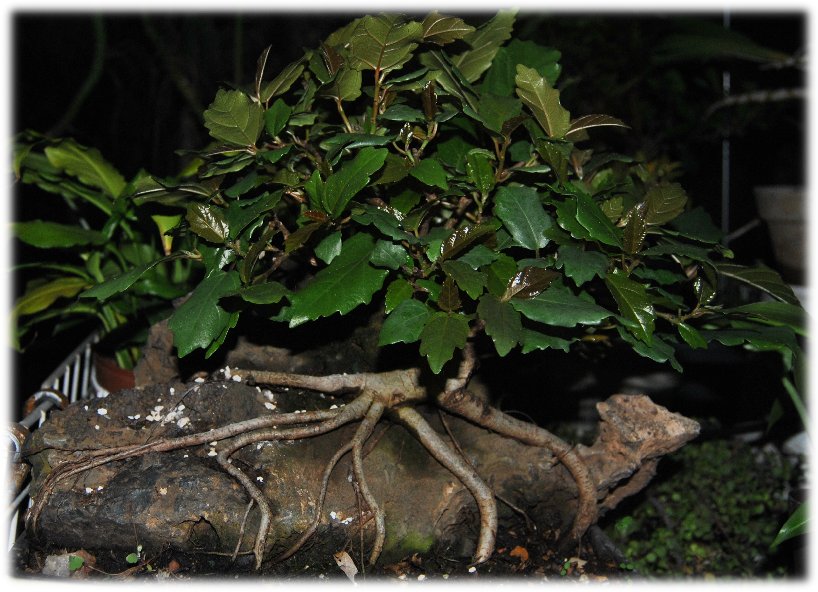
Here is a tree that was removed from the rotten core of another tree. Notice the very thick roots - almost Ginseng Ficus- like:

Dormant bonsai trees must still be watered but over watering them may lead to root rot.

Repotting and digging of yamadori should be done when temperatures have warmed up and when the trees are actively growing. Don't cut back thick trunks too heavily when digging because areas of the trunk may die if a root is not connected to a growing bud/twig/branch.

Die back after of the bark after twigs and roots were removed:

Before:
After:


When roots are reduced the crown must also be cut back. To prevent cut roots from rotting it is better to water the following day - the damp medium will provide enough moisture for the tree to survive the repotting. When watering it the following day dunk it in water until no bubbles are visible any more. From there water only when the medium is getting dry. Feed it regularly with your normal fertilizer.

Best to grow the trees in full sun- nodes will be shorter and leaves smaller.

When the trees are actively growing they can be cut back - leafless twigs will also bud out. Wounds on these trees will heal over time and there is no need to seal the wounds.

To get ramification the trees can be defoliated. Cut the tips of the twigs and remove all the leaves. New buds will pop up within a few days. Leaves on branches that are weak may be left.

Branches/twigs can be wired but keep an eye on them - the bite in quickly when the tree is growing actively! Thicker branches can be bend by using the notch or split branch method. Healing of a split branch may lead to reverse taper problems on a branch.

The growth of these trees fuse easily and grafting can be done - even roots can be grafted. Thick roots can be carved to make the nebari believable.

Carved roots before and after:


 The carving of the roots will be extended higher up the trunk because the upper trunk's bark looks too smooth. The roots entering the soil will also be carved some more to give the impression of the roots splitting up into secondary roots.

 Carved roots on a bigger tree(before and after):


Any bonsai style suits these trees but a wide open umbrella is the natural style here in Nortwest, South Africa. Banyan, root over rock and strangler style also looks very natural.

Some strangler bonsai by the expert Mack Boshoff. Notice the different stages of strangling the host:


 The master of this style, Mack Boshoff in action creating another strangler bonsai:
Almost the same as root over rock, but a living tree is used in the place of the rock.


The trees can be dug or grown from seeds or cuttings. Even very thick cuttings will strike. Letting cuttings dry out for a few hours in a shaded area will prevent them from rotting. New trees can also be grown from thicker roots.
  Root sprouting:

The trees air layer well.

A very big air layer where the pot method and not the sphagnum/plastic method was used :
The biggest advantage of this method is that the layer can be removed and no need for it to be potted up. It can be used with other species also.

Will update soon.


Saturday, September 1, 2012

In memory of Louis Nel.

 Louis Nel, the Buddleja King(Buddy) has died April 2011.

His world famous Buddleja:

Photo credit to http://www.artofbonsai.org/art-of-bonsai-awards/2009/aob_154_buddleja_saligna.jpg


Some pics of his last visit to our Kai on 16 April 2011:


Some of his trees he brought along:


REBEL WITHOUT A PAUSE - THE BONSAI WORLD WILL MISS YOU!


Thursday, August 9, 2012

Ficus sur - lots of potential!


Ficus sur is a large, fast-growing, evergreen tree, reaching up to 35 m high, with large, oval, green, sometimes slightly serrated on the edges, leaves borne on a massive, spreading crown.

 The typical leaf form of the trees here in Rustenburg, South Africa:

Figs are produced throughout the year in South Africa. They are borne in large clusters mostly low down on the trunk and can even appear at ground level or below the ground arising from the roots.
The racemes with fruit:

This majestic giant stands proud along side rivers and waterways throughout the eastern and northern regions of southern Africa- this indicate that they need a lot of water all the time!
It is restricted to frost-free areas with moderate rainfall.
The species is not well known or used much in the bonsai world but they do have potential:
  • They transplant easily.
  • They grow fast.
  • The leaves do reduce well.
  • They can be grown into any style and all the sizes except for the smallest.
  • They fruit on young trees.
  • The bark is multicolored.
  • No major pests or diseases.
  • Trees can be fused.
Most of my trees are grown from self sown seedlings - interesting enough they germinate in my pots and planting bags where other trees are growing in. Here you will never find them germinating in open soil in garden beds or even in the veld.

They rarely grow as stranglers or root over rock because the roots dry out too quickly.

When the trunks have reached the desired thickness the trees can be cut back and potted up. This is done when the trees are growing actively in high summer - digging up the trees in winter normally lead to their deaths by rot.
This is a yamadori I dug up in mid winter 2010:
It died! A very high prize to pay for gaining experience. Nowadays I do wait for the weather to warm up before digging this trees.

The trees recover quickly in summer and work can be done by the end of summer. Here is one potted up last summer(2011) and the chop worked off in April 2012:
Branches or trunks of this species can be fused. Here is three twigs that were fused using cable ties in 2009:
The same branch Aprl 2012:
One of the twigs died but the other two fused well. I will not use this for fusing branches again because a single twig could have grown as thick as the fused ones in the same time. Fusing trunks could be an option with this species.

To get ramification of the branches the tree should be left to grow freely for a while(at least four adult leaves) before being cut back to the last leaf. The last leaf can also be reduced by about 75%. Here is a tree that have been left to grow freely before being cut back and defoliated:

Defoliated and cut back:
From here it is important to pinch the new growth back to the second last leaf if you want to keep the leaves small. Defoliating can be done a few times in summer and autumn.

It is best to wire trees to style them but make sure that the wires don't bite in.

Wounds on the trees heal well and the deadwood last quite long. Here is the cambium rolling over after the worked off chop:
Trees can probably be grown into any styles but I believe an open umbrella suits this species well. It can be grown root over rock but you may get roots dying if they get too hot in full sun. Racemes and fruits forms on young plants and can be left as a nice talking point!

The trees can be planted in a high organic medium - 50% gravel and a good compost will do fine. The high compost content will also prevent the tree from drying out too quickly - on this species drying out may lead to massive die back! This species responds well to organic or inorganic fertilizers.

The nebari on this species can be build by using sacrifice branches.

Progression of a Ficus sur bonsai:
November 2011:
:
 February 2014:
 From the top:

The yellow indicates the current front. The front will change when the rest of the canopy has caught up with the area indicated by the yellow arrow.


Sunday, August 5, 2012

Formal upright Buddleja saligna.

I got this Buddleja saligna yamadori in 2009:

What drew me to the tree was the nebari: it looked good from a few sides. I did not have a formal upright tree so I decided to style this one as an old formal upright lightning struck tree with sweeping downward branches.
The species is an ideal bonsai candidate for the style because the leaves reduce very well and the wood is quite hard - a tree this size is probably more than 50 years old!

The biggest problem with this species, especially on older trees, is that the roots are directly connected to certain branches. When digging the yamadori, it is not normally a problem, but when working on a tree a cut root can mean a dead branch. It can also mean that the "vein", connecting the two may die leaving you with dead bark and later a deadwood strip.

The tree also bud out on these veins, so the branches on a vein must be balanced to keep each branch on the vein an equal chance to survive- if the lowest branch on a vein is left unchecked, higher up branches may die.

Because the tree is basal dominant it was important to me to get the highest growths as strongly growing as possible.

I carved back the top of the trunk to the last living buds to create some taper. This would be refined later on. The biggest reason for the carving at that stage was to see which buds/growths would survive.
The tree after the carving:
The new apex was picked up and wired to the deadwood. I was crucial that I get it as healthy as possible and with so much growth as possible so I decided to grow a little trunk line with branches there. Here is the apex picked up:
The tree June 2010:

As the tree was budding out I bend the twigs downwards as soon as possible to prevent them from being torn off the trunk later on. At that time I still need a lot of branches so I nurtured every bud showing by cutting back older branches.

By October 2010 the tree was coming along nicely:
Much needed higher and lower branches has budded out.

By December 2010 I decided to extent the carving to where the bark has died naturally:
February 2012 I extended the deadwood to the base of the tree:
In April 2012 I decided to thin out the foliage a bit because the inner leaves began to go brown - they were not getting enough sunlight.
Big mistake!
After the thinning we had a cold spell and the tree suffered through winter. Winter here is May-July. Early July I slip potted the tree into a bigger container because it showed new growth. It has recovered well and I did some refining carving.

Will update with the newest pictures in the next week.